
An important work of fiction which wraps the author’s experiences into a clarion call for all former warfighters: Inform the next generation and stop the spread of the war machine and all it continues to destroy in its wake.
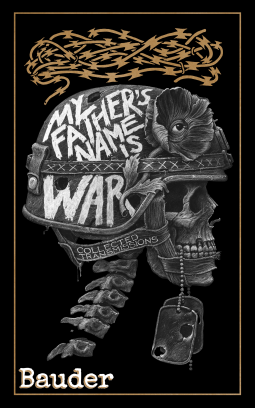
When I found out I might be able to interview Bauder for their debut novel My Father’s Name is War: Collected Transmissions, I nearly cried. This book is deeply moving and personal, and even before I had finished it, I knew I wanted to connect with Bauder. A veteran of the Afghanistan War (Operation Enduring Freedom), Bauder offers a different perspective of war through science fiction and horror. A book about war that neither glorifies nor sanitizes it.
Enjoy our interview, and please pick up a copy of My Father’s Name is War: Collected Transmissions from Bookshop.org to support indie publishers!
McKenna: Was there a single motivating factor that spurred you to write My Father’s Name is War?
Bauder: Not so much a single factor. I would say it was more a case of things catching up with me. The war in Afghanistan had ended, and I found myself questioning why it was necessary to experience the things I did. I had recently lost a friend who left the service a few years prior. Growing complications in my physical and mental health were demanding my daily attention, forcing me to come to terms with their origin. I think I outgrew the sense of invincibility we associate with youth and discovered mortality, a sense of just how finite my time could be.
M: Your stories are raw and emotional, clearly coming from close familiarity with war, and those of comrades or family; your dedication alludes to as much. How would you describe your experience in the military?
B: It’s probably a cliché at this point, but my experiences in the military represent some of the best and worst times of my life. It’s almost impossible to look at those events as they happened, the good and the bad, without some sense of longing. This nostalgia (for both the highs and lows) contributes to a very real sense of shame I think is natural for veterans to experience. To have your identity in lock-step with your job, your purpose, your community, and the perception of outside communities … everything feels right. Even so, you can’t help that nagging feeling at the back of your mind that the interlinked nature of those factors is artificial. The breakdown of trust (not just in people, but in the environment, yourself, everything) that accompanies trauma sets the stage for one’s confrontation with reality.
M: Reading the book, there is a thread of disillusionment with war and the acknowledgement of moral injury as a result of participation in the war machine woven throughout. As the spouse of a combat vet, I relate deeply to these themes. You ask those who read your words to share their experiences with younger generations to hopefully escape this hellish cycle of violence. Is there anything else you hope veterans and their families will take away from your stories?
B: I primarily wrote my stories to convey the nature of consequence to those who, I hope, will never have to experience it themselves. It was incredibly difficult to translate consequence from abstract reality (“We can simply never understand the true nature of a veteran’s sacrifice…”) into something more closely resembling truth. I want veterans and their families to know that any suffering they may be experiencing is not abstract; it’s not locked behind a door painted over with the words “Thank You for Your Service.” What you’re experiencing is similarly experienced by others touched by trauma and moral injury. The generations before us were similarly stained, spoke the same language. At some point, a generation will collect its thoughts and end this relationship with conflict. Why not ours?
M: My husband (who is reading the book with me) said he’s just happy someone was able to put his feelings into words. For the veterans out there who are questioning their involvement with the military industrial complex, who have seen the horrors of war, or “been in the shit”, and now feel disconnected from those glorifying war, what insights do you think they can take from My Father’s Name is War?
B: War is a social construct, one that produces obscene benefits for a select few. One of its core narratives requires a quasi-religious view of sacrifice—the sacrifice of an increasingly shrinking population for the benefit of the many. Conflict is more a system of being than any event or series of events, and we’re seeing the consequences of the Global War on Terror manifest across society, not just in the veteran population. To disconnect not just from those we disagree with, but from everything, is a natural experience for veterans. I see it in job histories, in broken marriages, in criminal records and life expectancies. As much as we would like to hope that we can find connection in careers or activities adjacent to the military, it’s just not that simple. Building an understanding of what healthy connections are and can be first requires a look in the mirror. I hope this book can provide that.
M: My husband is curious to know if your relationship with your unit affected how you view the world and the military in general. He has himself lost friends to the “fetishization” of patriotism, to the point of rejecting the veteran community altogether. Would you say you had a similar experience?
B: I was able to experience the cultures and behaviors of a few different units during my time. I can say that some treated me like an asset, while others treated me like property. I will also say that trust is a social currency, one with a value that fluctuates based on the environment. When you depend on those around you and those above you for security, to defend your very life, trust is exchanged easily (a valuable survival mechanism) but can be irreparably lost. When we choose to leave the military, we seek ways to justify or make amends with that decision—it’s no small feat to reject, discard, or remake identity. In the case of veterans fetishizing patriotism, if we can understand where it comes from (the relationship with identity, a desire for economic security, etc.), we have a better means to reach out and address it.
M: In the front matter of the book, you direct readers to do their own research on the Global War on Terror and form their own opinions. At the end of this statement you say, “No single viewpoint is valid until you are capable of viewing anything objectively. That is, when you know your personal history, biases, and allegiances so well, you can look beyond them for the sake of achieving greater understanding.” It’s clear that you have an open mind and are empathetic. Do you see your stories as a tool to build empathy among others?
B: The stories (and the greater book) are designed as a tool, a means to frontload the 17-year-old version of myself with the experience needed to (a) make a decision about military service, and (b) navigate a society reshaped by the Global War on Terror Era. Empathy is certainly a necessary requirement; it’s one I did not have the opportunity to exercise until after I left home. I suppose only time will tell if this book is capable of breaking down existing barriers to empathy and progress.
M: With the current state of our country, and world, in what ways would you want your work to be conceptualized and acted upon?
Bauder: If I can better inform one kid’s decision on whether to enlist, to bring some balance to the forces at work on them in that time, I’ll consider the book a success.
My Father’s Name is War: Collected Transmissions is available now!




 Temple of Dead Trees
Leave a comment